


This is Part II of Strait Outta Taiwan’s ongoing series examining Han Kuang 42 Exercise (漢光42號演習, HK42), taking place from August 5-14. Part I explored the preparatory activities that began before the exercise’s official start date. This installment examines reserve mobilization and whole-of-society defense resilience, two efforts that underpin the exercise’s live-fire phase.
Read Strait Outta Taiwan’s HK42 analysis here:
The key point is that HK42 did not begin when the live-fire phase opened. It began when Taiwan started testing whether people, equipment, local governments, civilian infrastructure, and reserve units could be moved from peacetime routines into a usable wartime posture.
I observed part of HK42’s live-fire range training in northern Taiwan and spoke with TaiwanPlus from the beach as the drills unfolded behind us. The interview focused on what the mobilization and live-fire activity revealed about Taiwan’s broader readiness cycle.
I. Han Kuang Started before August 5
HK42 is scheduled to begin its live-fire phase on August 5, but the exercise has already been underway since late July. The early signals of HK42’s quiet ramping up were not dramatic missile launches or armored columns, but recall orders, report windows, equipment issues, unit formation, mobilization support desks, and reservists moving toward assembly points island-wide. The warm-up to HK42 is not only a test of how Taiwan’s active-duty force fights, but how quickly Taiwan can generate usable wartime forces from its reserve system.
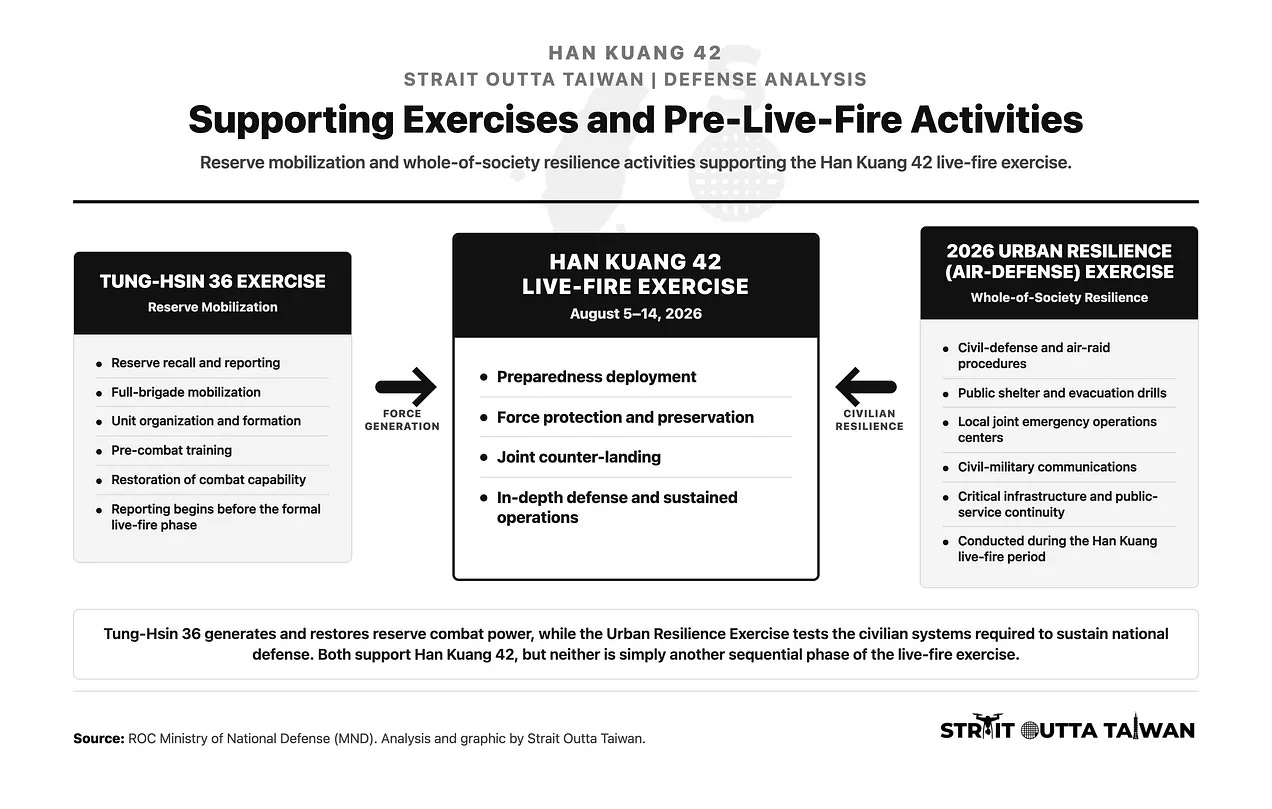
As the live-fire exercise occurs for HK42, it is supported and complemented by two other exercises — Tung-Hsin 36 Exercise (同心36號演習, TH36) and 2026 Urban Resilience Air Defense Exercise (2026城鎮韌性(防空)演習). Whole-of-Society Defense Resilience (全社會防衛韌性) is a focus of President Lai Ching-te (賴清德總統); his Administration established its committee and elevated the Ministry of National Defense’s (國防部, MND) All-Out Defense Mobilization Agency (全民動員署, ADMA).
One of HK42’s several training items is Whole-of-Society Defense Resilience to ensure civil-military coordination through Local Joint Emergency Operations Centers (聯合應變指揮管制中心, LJEOC) between the MND, ADMA, and county and city governments. Both TH36 and the Urban Resilience Exercise will fit into the Whole-of-Society Defense Resilience portion of HK42’s live-fire exercise.
II. Reserve Mobilization & Whole-of-Society Defense Resilience

As HK42 approached, Taiwanese netizens shared their mobilization experiences on social media. According to reports, HK42 will mobilize two brigade-level reserve units — one in northern and one in southern Taiwan — of up to 5,000 reservists. Many posted public notices that their businesses will be closed between August 1-14 due to mobilization. Attached to HK42 is TH36, which supports Taiwan’s ability to mobilize reservists island-wide. Through TH36, MND planners can test whether reservists:
Receive and comply with recall orders.
Report to assigned units and assembly points.
Complete mobilization and unit formation requirements.
Transition from a peacetime reserve status to deployment readiness or wartime operational roles.
What stands out about the recalls for TH36 is several of the broader trends that it reveals about how Taiwan is preparing for combat readiness:
Nationwide geographic distribution: Recall notices appeared across Taiwan’s main island and outer islands, suggesting a model of local forces defending local areas rather than concentrating mobilization in one place.
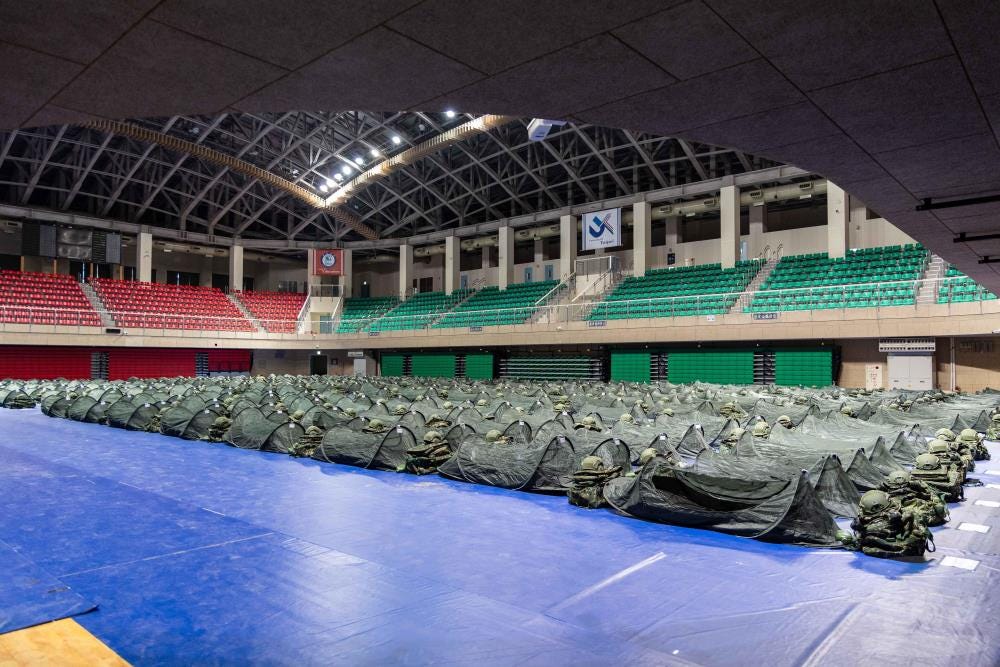
Assembly points around civilian infrastructure: Most of the assembly points for reservist mobilization were not MND facilities or bases, but key civilian gathering points amongst their local communities like universities, grade schools, temples, community centers, veterans homes, cultural parks, power plants, and transportation hubs.
Planning timeline: Many notices were sent out weeks or months in advance, indicating that recalls were a part of a planned mobilization cycle and not ad hoc, feeding into the planning that dominates HK42’s continuous training cycle.
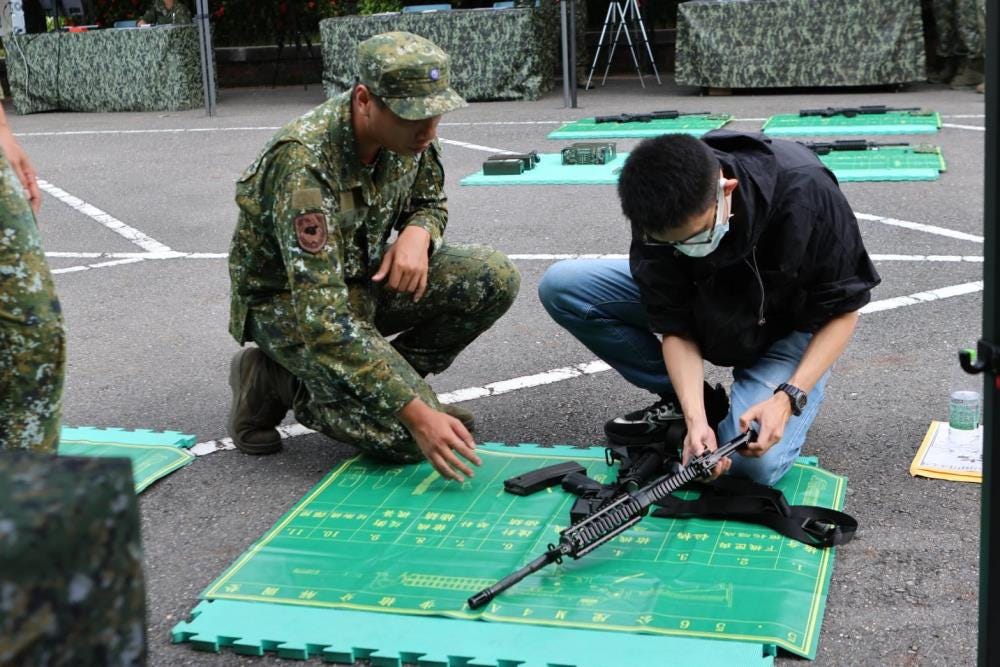
Modernized individual equipment: Reporting notes that some reservists are receiving or training with newer equipment like M4A1 carbines, helmets, tactical vests, ballistic plates, uniforms, and drones. That matters because it ensures they can be re-equipped, sorted by specialty, and be operationally useful once mobilized.
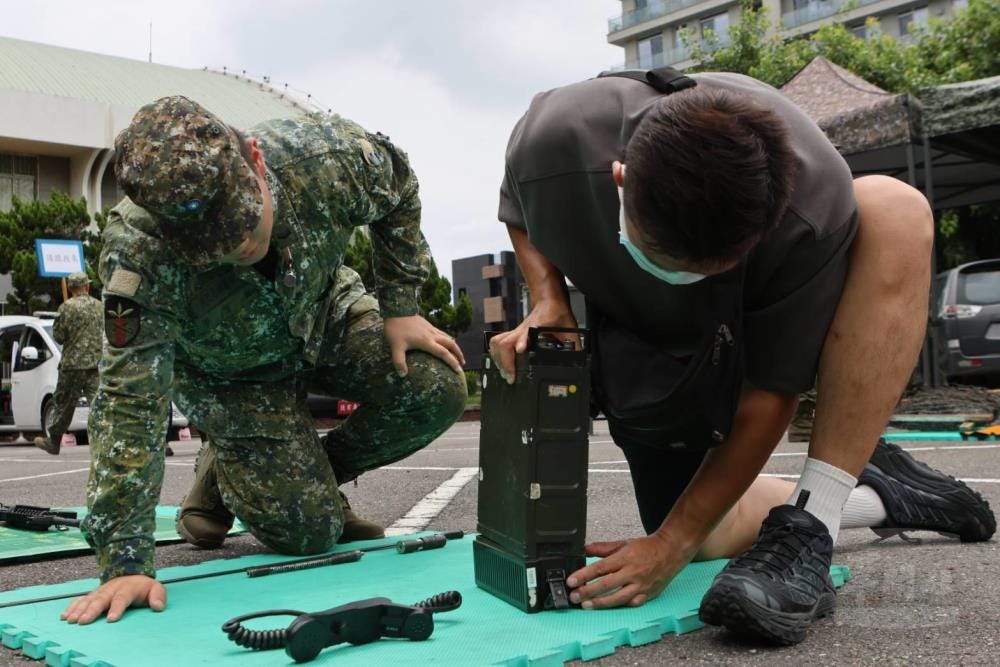
According to reporting and what has been shared by Taiwanese netizens, much of the reserve mobilization is tied to “speciality identification (專長鑑定).” Reserve forces are only useful if the MND can match personnel to wartime tasks within functioning units. Given the breadth and depth of the various units that have been recalled, across all five of Taiwan’s service branches — infantry, engineering, communications, logistics, etc. — the ability to assign these mobilized reservists to specific functions shows that MND is trying to regenerate multiple wartime capabilities.
It remains to be seen how recalled units perform, something that HK42 will shed light on over the first half of August. Still, the process of issuing notices, reporting windows, assembly points, equipment issue, and planned specialized training is important unto itself. Assigning mobilized reservists quickly in the early stages of a Taiwan contingency could be the difference between life and death when a crisis arrives.
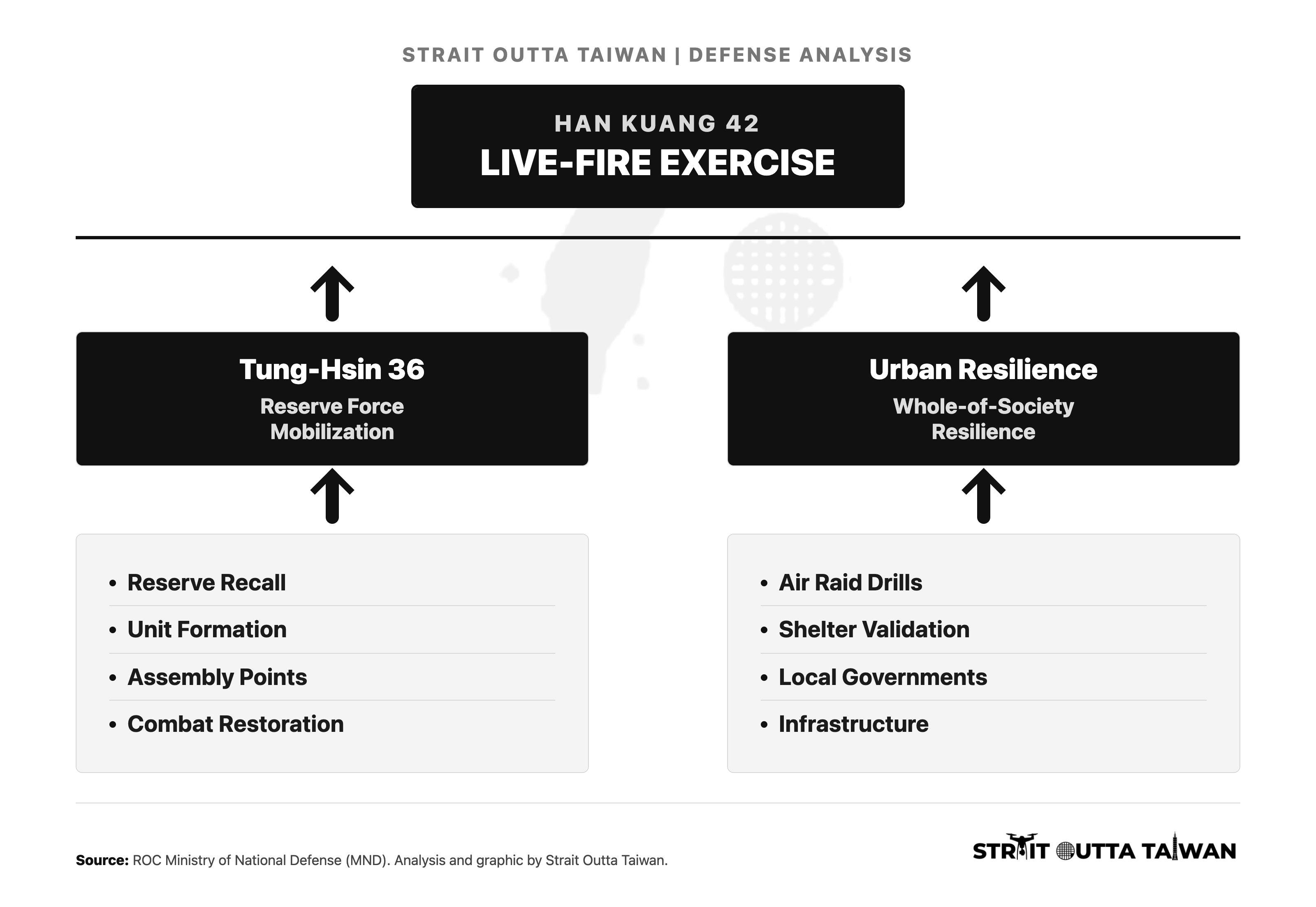
Throughout the Immediate Readiness and Joint Defense Exercises earlier this summer, urban resilience was already visible through testing civilian medical networks and hospitals. Although much about the Urban Resilience Exercise has not been as visible yet, the use of civilian infrastructure for TH36, the roles that LJEOCs will play, and the occurrences for the Urban Resilience Exercise on August 7 and 10-13 around Taiwan and its outer islands show how HK42’s live-fire exercise, TH36’s reserve mobilization, and the Urban Resilience exercise all fit together.
HK42’s live-fire phase may draw the headlines, but it rests on weeks of quieter preparation. Reserve mobilization, equipment issue, civilian infrastructure, and whole-of-society coordination are not separate activities — they are the foundation that allows Taiwan’s military to generate combat power before the first shot is fired. This matters because Taiwan’s defense problem is not only whether active-duty units can fight, but whether the state can regenerate combat power, sustain civil order, and keep local systems functioning under pressure.
If you found this installment useful, consider subscribing to Strait Outta Taiwan to receive future installments directly in your inbox.